This page was translated automatically from Turkish. Read the original
← Back to blogWhat are the effects of saffron during pregnancy?
Saffron use during pregnancy: What do we know?
Human data on saffron (Crocus sativus) during pregnancy are limited, while animal data indicate a risk of miscarriage and adverse fetal effects at high doses.
1. Miscarriage and effects on the fetus
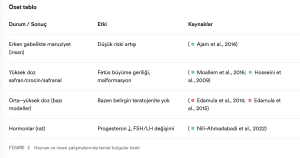
- Among female farmers, the miscarriage rate was 10.6% in those who continued working in saffron fields, compared with 0% in those kept away; exposure significantly increased the risk of miscarriage ( Ajam et al., 2014).
- In mice and rats, high doses of saffron or its constituents (crocin, safranal) caused embryonic loss, growth restriction, and skeletal malformations ( Moallem et al., 2016; Hosseini et al., 2009).
- While some rat studies found no significant teratogenicity at doses up to 500–1000 mg/kg ( Edamula et al., 2014; Edamula et al., 2015), others reported impaired placental vascular development and severe toxicity at lower doses and with different timing of exposure ( Elfatih & Eltawilll, 2022; Fatih, 2021).
- Saffron has been shown to lower progesterone and alter FSH/LH levels, which may be associated with abortifacient effects, particularly in early and late pregnancy ( Nili-Ahmadabadi et al., 2022).
2. Dose, trimester, and other considerations
- In traditional medicine, saffron has been described as an abortifacient (a substance that induces miscarriage) ( Gorginzadeh & Vahdat, 2018).
- Systematic reviews emphasize that saffron generally appears safe for adults at 30–50 mg/day, but that high doses and unsupervised use are particularly inadvisable during pregnancy (Lu et al., 2021; Goyal et al., 2024; Marrone et al., 2024).
- A study conducted during lactation found histological changes in the kidneys of offspring at high doses; breastfeeding mothers are advised to avoid very high doses (Bahmani et al., 2014).
Conclusion
Current evidence suggests that saffron may generally be safe for adults at therapeutic doses or in normal culinary amounts, but that it carries potential risks of miscarriage and adverse fetal effects during pregnancy, particularly in the first half of pregnancy and at high doses. The safest approach during pregnancy is to avoid using saffron medicinally (in capsules, concentrated teas, etc.), limit it to very small culinary amounts, and discuss even this use with your obstetrician.
References
Ajam, M., Reyhani, T., Roshanravan, V., & Zare, Z. (2014). Increased Miscarriage Rate in Female Farmers Working in Saffron Fields: A Possible Effect of Saffron Toxicity. Asia Pacific Journal of Medical Toxicology, 3, 73-75. https://doi.org/10.22038/apjmt.2014.3047
Bahmani, M., Rafieian, M., Baradaran, A., Rafieian, S., & Rafieian-Kopaei, M. (2014). Nephrotoxicity and hepatotoxicity evaluation of Crocus sativus stigmas in neonates of nursing mice.. Journal of nephropathology, 32 , 81-5. https://doi.org/10.12860/jnp.2014.16
Edamula, R., , M., Kumar, D., Krishnamurthy, H., & Latha, M. (2014). Prenatal Developmental Toxicity of Crocus sativus (saffron) in Wistar rats. , 2 , 46-49. https:/ /doi.org/10.14419/ijpt.v2i2.3035 Edamula, R., , M., , M., Kumar, D., & , K. (2015). EVALUATION OF TOXICITY OF CROCUS SATIVUS (SAFFRON) DURING EMBRYOGENESIS IN WISTAR RATS. International journal o f pharma and biosciences.
Elfatih, N., & Eltawilll, G. (2022). Impairment of placental angiogenesis in rats treated with saffron: The role of low dose gamma irradiation. Arab Journal of Nuclear Sciences and Applications. https:/ /doi.org/10.21608/ajnsa.2022.118229.1547Fatih, N. (2021). Impairment of Placental Angiogenesis in Rats Treated with Saffron: The Role of Low Dose Gamma Irradiation. I n t ernational Journal of Clinical Studies and Medical Case Reports. https:/ /doi.org/10.46998/ijcmcr.2021.14.000343
Gorginzadeh, M., & Vahdat, M. (2018). Smooth muscle relaxant activity of Crocus sativus (saffron) and its constituents: possible mechanisms. Avicenna Journal of Phytomedicine ,8 , 475-477. https://doi.org/10.22038/ajp.2018.11481
Goyal, A., Raza, F., Sulaiman, S., Shahzad, A., Aaqil, S., Iqbal, M., Javed, B., & Pokhrel, P. (2024). Saffron extract as an emerging novel therapeutic option in reproduction and sexual health: recent advances and future prospectives. Annals of Medicine and Surgery, 86, 2856 - 2865. https://doi.org/10.1097/ms9.0000000000002013
Hosseini, S., Dashti, R., Anvari, M., & Zeinali, F. (2009). The abortificant effects of different doses of saffron (Crocus sativus) decoction in mice. https:/ /doi.org/10.1055/s-0029-1234792
Lu, C., Ke, L., Li, J., Zhao, H., Lu, T., Mentis, A., Wang, Y., Wang, Z., Polissiou, M., Tang, L., Tang, H., & Yang, K. (2021). Saffron (Crocus sativus L.) and health outcomes: a meta-research review of meta-analyses and an evidence mapping study. Phytomedicine: international journal of phytotherapy and phytopharmacology, 91, 153699. https://doi.org/10.1016/j.phymed.2021.153699
Marrone, G., Urciuoli, S., Di Lauro, M., Cornali, K., Montalto, G., Masci, C., Vanni, G., Tesauro, M., Vignolini, P., & Noce, A. (2024). Saffron (Crocus sativus L.) and Its By-Products: Healthy Effects in Internal Medicine. Nutrients , 16 . https://doi.org/10.3390/nu16142319
Moallem, S., Afshar, M., Etemad, L., Razavi, B., & Hosseinzadeh, H. (2016). Evaluation of teratogenic effects of crocin and safranal, active ingredients of saffron, in mice. Toxicology and Industrial Health, 32 , 285 - 291. https://doi.org/10.1177/0748233713500818
Nili-Ahmadabadi, A., Artimani, T., Sepehr, A., Kaloorazi, Z., Behnamfar, Y., Larki-Harchegani, A., Ranjbar, A., Dastan, D., Azandaryani, M., & Ahmadimoghaddam, D. (2022). The effect of saffron and its constituent, crocin, on anterior pituitary-gonadal axis during pregnancy in the rat: A time-course study. South African Journal of Botany. https://doi.org/10.1016/j.sajb.2022.04.001