This page was translated automatically from Turkish. Read the original
← Back to blogWhat Can EMDR Offer People Living with Dementia and Their Carers? (What can EMDR offer people living with dementia and their carers?)
Authors: Jonathan Hutchins, Khyati Rawal, Henk Swanepoel, Lucilla De Mattia, Clare Keogh
Translated by: Specialist Psychologist Elena Gizem Pozam
Introduction
Dementia is an umbrella term describing a decline over time in cognitive functions such as memory, thinking skills, comprehension and speech. The personal, societal and economic impact of dementia is enormous.
According to NHS England (2024), as of April 2024, 481,783 people had been diagnosed with dementia, of whom 33,711 were diagnosed before the age of 65. The Alzheimer’s Society estimates that the actual number of people living with dementia in the United Kingdom (UK) is 900,000, and that this could rise to 1.6 million by 2040. Of the 900,000 people living with dementia in the UK, more than 78,000 are under the age of 65, and 25,000 are from Black, Asian and minority ethnic groups. One in six people over the age of 80 has dementia.
The UK charity Dementia Carers Count states that there are 700,000 family carers of people with dementia in the country, and that this number is projected to reach 1.6 million by 2040 (in parallel with the increase in the number of people who will develop dementia). Two-thirds of people with dementia in the UK live at home, and most are supported by unpaid carers. The number of people leaving employment to care for someone with dementia is expected to rise from 50,000 in 2014 to 83,100 in 2030.
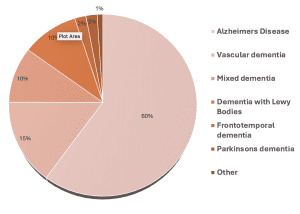
There are different subtypes of dementia, and the distribution of these types is shown in Figure 1 below.
https://dementiastatistics.org/about-dementia/subtypes/
Each subtype has a distinct neuropsychological profile of behavioural and psychological symptoms of dementia (BPSD), which can present unique challenges for families, carers and care staff. We considered each subtype and whether EMDR could benefit people living with dementia. We also explored how EMDR could support families, carers and care staff in managing these symptoms.
Target Selection for EMDR
Various experiences and symptoms can give rise to a traumatic event for both the person living with dementia and those caring for them. We considered the progression of the condition and the possibility that individuals may experience more than one subtype of dementia at the same time.
It could be argued that there is greater scope for standard-protocol EMDR interventions in the early stages of dementia, when cognitive abilities are more intact. As the condition progresses, the need for adapted EMDR approaches increases, as does the difficulty of establishing a therapeutic alliance and/or identifying specific experiences to target.
Studies have shown that EMDR has been used in the early stages of dementia to address previous psychological trauma, such as the trauma of receiving a diagnosis (Ruisch et al., 2023; Amano & Toichi, 2014.). In addition, EMDR has been shown to effectively reduce BPSD by addressing the content of rumination (repetitive negative thoughts) and trauma associated with hallucinations and delusions, thereby alleviating these symptoms (Adams et al., 2020).
Past Targets
Considering EMDR’s three-pronged approach to past, present and future triggers (Shapiro, 2017), past experiences that could be considered as targets using the standard protocol include:
- A history of powerlessness or loss of control: These experiences may underlie the person’s response to the way their diagnosis was delivered.
- Previous experiences of dementia or illness in the family: For example, witnessing a parent’s or loved one’s experience of dementia may contribute to current and future fears about the progression of one’s own condition.
- Early attachment history: Experiences of being cared for in childhood, particularly if they involved abuse or neglect, may influence future fears when the need for care arises as the condition progresses. In addition, attachment disappointments may be re-enacted between the individual and their carer, creating scope for other potential EMDR targets.
Current (Present) Targets
We recommend taking a collaborative, person-centred approach when working with both the individual and their carers. Current memories/experiences that could be considered as EMDR targets include:
- The moment of receiving the diagnosis.
- Moments of self-awareness associated with specific symptoms of dementia, such as urinary incontinence, hallucinations/nightmares or episodes of challenging behaviour.
Current EMDR targets for carers could include:
- The first time their loved one experienced symptoms such as urinary incontinence, significant memory loss or challenging behaviour.
- Impactful moments when the loss becomes clear, such as witnessing significant personality changes in their loved one’s behaviour.
Adjustment and Loss
Both the person living with dementia and their carers are likely to experience a period of adjustment and transition associated with dementia. This process can be understood in relation to the literature on the cycle of grief and loss described by Kübler-Ross (1969).
In the early stages following diagnosis, both the individual and their carers/family may experience denial, shock and avoidance, potentially leading to anger. The moment of diagnosis can itself be a traumatic memory. This may provide a key initial target for EMDR processing to help increase understanding and acceptance of the diagnosis and to focus on coping skills for both the present and the future.
In addition, as the individual moves through this cycle, they may compare themselves with who they used to be or what they used to be able to do. This comparison and focus on the past can be a significant source of anger and sadness for the individual and their carers. EMDR may be useful in targeting a recent experience of failure or BPSD to reduce the emotional and potentially traumatic impact on individuals and carers, and may enhance resilience and coping strategies through adaptive information processing (AIP).
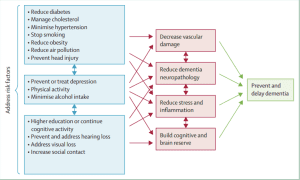
Another concern for carers is the possibility of developing dementia themselves. A systematic review by Livingston and colleagues (2020), published in The Lancet, examined the most effective, evidence-based approaches both to preventing dementia and to providing interventions for those affected. Figure 2, taken from this paper, highlights the importance of maintaining a healthy diet, stopping smoking, reducing alcohol consumption, preventing and treating depression, and increasing exercise and social contact; all of these may contribute to reducing the risk of developing dementia.
It is important to use this information sensitively and only when appropriate, as people who adopt a healthy lifestyle can also develop dementia, and we would not want this information to be used to shame anyone. However, sharing this diagram (referring to the information in Figure 2) with carers may help guide interventions aimed at increasing their social contact or participation in peer support groups. One study used the EMDR Integrative Group Treatment Protocol with carers (Passoni et al., 2018) and showed that the intervention reduced stress-related symptoms, anxiety and depression in carers of people with dementia.
Future Targets
Considering the third prong of the EMDR approach (Shapiro, 2017), future targets for people living with dementia and their carers could include:
- Identifying Three Qualities: Identifying three positive qualities to draw on resources from the life experiences of the individual and their carer to cope with future changes associated with dementia. These qualities may include elements such as resilience, determination and control in the past and present. These positive qualities can help both the person living with dementia and their carer plan for the future and identify the type and level of care they would like to receive.
- Future Template: Building on the three qualities identified, it may be possible to use a future template in which the individual imagines themselves coping with the condition, drawing on their resilience and ability to manage challenges.
- Flash Forward: This technique can be used to target the feared worst-case scenario concerning the later stages of the condition and/or death. It should only be considered if the individual or carer is catastrophising about the future to such an extent that it interferes with their ability to cope with the present situation.
Other targets for EMDR with carers may emerge in relation to family attachment dynamics and their relationship with the person living with dementia. These targets may include memories of past attachment trauma that arise for carers. Such memories may also be useful targets for EMDR reprocessing, as this could help reduce levels of carer depression, anxiety and burden associated with managing BPSD. In addition, future planning concerning the later stages of the condition, death and early symptoms of grief (such as denial and anger) is important. EMDR’s role here may involve using resources such as the three qualities, developing a future template for care or funeral planning, and processing recent carer experiences, such as the person forgetting who they are.
Potential Challenges of Using EMDR with This Client Group
Although different subtypes of dementia have specific symptom profiles, each person living with dementia and their carers experience a unique journey and combination of challenges. This can make it difficult to determine whether the individual is in the early, middle or late stages of the condition. Another factor to consider is that people living with dementia are increasingly living alone, creating challenges in remembering appointments, meeting personal care/health needs and managing risk. Assistive technology is a potential source of psychosocial intervention in this context, with a growing evidence base (Rai et al., 2022). Other considerations, drawing on Neuro EMDR (Hutchins & Proudlock, 2023), could include cognitive adaptations to the standard EMDR protocol, such as using external cues for safe/calm place work, providing shorter sets of bilateral stimulation and offering more help with identifying appropriate negative and positive cognitions.
Advanced Stages of Dementia
As the individual’s dementia progresses, the standard protocol may need to be adjusted, as they may be unable to participate in a formal therapy session or answer the specific questions in the assessment phase of EMDR. At this stage, we recommend using the on-the-spot EMDR method (Amano & Toichi, 2014). This method has been adapted for use with individuals displaying challenging behaviour in inpatient settings. The authors used the following approach:
- Phase 1 – History: As it was not possible to obtain information from the client, the therapists drew on the client’s care plan, collateral information from family members and/or life story work.
- Phase 2 – Stabilisation: Because significant memory impairments meant that clients could often forget the therapist after seeing them, the therapist would reintroduce themselves each time they saw the client and draw on previous sessions and/or collateral information for safe place work and similar interventions.
- Phase 3 – Assessment: The on-the-spot EMDR method assumes that the client’s challenging behaviour represents traumatic material, as the client is unable to communicate the details of the target image, the negative cognition associated with the traumatic memory, the positive cognition and so forth.
- Phases 4, 5, 6 and 7: The therapists used tactile bilateral stimulation rather than eye movements for reprocessing because of eye-related difficulties in older age and the cognitive demands of eye movements.
- Phase 8 – Re-evaluation: As re-evaluation through direct questioning of clients was not possible, the therapists assessed outcomes using antecedent, behaviour, consequences (ABC) chart data and staff reports of the frequency and severity of challenging behaviour.
The authors observed reductions in both the frequency and severity of challenging behaviour (Amano & Toichi, 2014; Amano & Toichi, 2016). It may be possible to teach carers aspects of this protocol and support them in using it to reduce challenging behaviour and stress by helping the person living with dementia regulate their emotional state.
Summary and Recommendations
This article proposes a range of ways in which EMDR may benefit people living with dementia and their carers/families. Dementia is a complex and significant condition, and the authors intend this article to serve as an introductory guide that encourages practitioners to use EMDR to help improve the quality of life of this client group.
Currently, there is a limited evidence base supporting the use of EMDR with people living with dementia, and we strongly recommend further research in this area. When considering options for future research, we recommend not only measures of symptom reduction or reductions in challenging behaviour, but also measurements of clients’ physiological responses before, during and after EMDR processing. For example, studies could use wearable technologies such as smartwatches or smart socks to investigate whether EMDR has a long-term impact on the physical health and sensory integration of people living with dementia.
In addition, we recommend focusing on EMDR’s potential effects on sleep quality and overall quality of life.
References
Adams, R., Ohlsen, S., & Wood, E. (2020). Eye Movement Desensitization and Reprocessing (EMDR) for the treatment of psychosis: a systematic review. European Journal of Psychotraumatology, 11(1), 1711349.
Amano, T, L., Toichi, M. (2014). Effectiveness of the On-the-Spot-EMDR Method for the Treatment of Behavioral Symptoms in Patients With Severe Dementia. Journal of EMDR Practice and Research, Vol 9 (2).
Amano, T, L., & Toichi, M. (2016). The role of alternating bilateral stimulation in establishing positive cognition in EMDR therapy: A multi-channel near-infrared spectroscopy study. PLOS One, 11(10).
Hutchins, J., & Proudlock, P. (2023, Summer). Neuro EMDR: Applying EMDR therapy with clients who have impaired cognitive abilities. EMDR Therapy Quarterly.
Livingston, G., Huntley, J., Sommerlad, A., Ames, D., Ballard, C., … Mukadam, N. (2020). Prevention of dementia and cognitive decline: A systematic review. The Lancet, 396(10248), 413-446.
Passoni, S., Puggina, A., Fernandez, I., Fernández, A., & Morris, L. (2018). Eye movement desensitization and reprocessing integrative group treatment protocol (EMDR-IGTP) applied to caregivers of patients with dementia. Frontiers in Psychology, 9, 572.
Rai, H. K., Kernaghan, D., Schoonmade, L., Egan, K. J., & Pot, A. M. (2022). Digital technologies to prevent social isolation and loneliness in dementia: A systematic review. Journal of Alzheimer’s Disease, 90(2), 513–528.
Ruisch, J. E., Nederstigt, A. H. M., van der Vorst, A., Boersma, S. N., Vink, M. T., Hoeboer, C. M., Olff, M., & Sobczak, S. (2023). Treatment of post-traumatic stress disorder in people with dementia: a structured literature review. Psychogeriatrics : the official journal of the Japanese Psychogeriatric Society, 23(3), 523–534.
Shapiro, F. (2017). Eye movement desensitization and reprocessing (EMDR) therapy: Basics and beyond (2nd ed.). Guilford Press.
← Previous
🧠 Neuro EMDR: Applying EMDR Therapy with Clients Who Have Impaired Cognitive Abilities (Neuro EMDR: Applying EMDR therapy with clients who have impaired cognitive abilities)
Next →
Ketamin Destekli EMDR Terapisi™ Travma Sonrası Stres Bozukluğu (TSSB) İçin: Farmakoterapi ve Psikoterapinin Sinerjik Etkilerinin İncelenmesi (Ketamine-Assisted EMDR Therapy™ for Posttraumatic Stress Disorder (PTSD): Examining the Synergistic Effects of Pharmacotherapy and Psychotherapy)