This page was translated automatically from Turkish. Read the original
← Back to blogTranslation: The Effect Of EMDR Vs. EMDR 2.0 on Emotionality and Vividness of Aversive Memories in a Non-Clinical Sample
EMDR therapy is an effective and safe treatment for many psychiatric disorders, particularly PTSD. Ahead of the event we will be holding next January, with Ad de Jongh and Suzy Matthijssen as speakers, we would like to share a translation of their article. You can read the article, translated and summarized by psychologist Derin Kubilay, below.
Introduction
Measuring effects on PTSD is one thing; improving a treatment by understanding its underlying mechanisms is quite another. Experimental research provides an opportunity to study therapeutic procedures. This allows us to understand not only a therapy's efficacy but also how that efficacy can be improved. For example, EMDR is one of the leading treatments of choice for PTSD. This procedure has proven both effective and efficient.
However, not all clients respond to treatment in the same way. Another version of EMDR therapy has been adapted specifically for clients who do not respond. Improvements to the efficacy of EMDR therapy have been investigated in experimental studies, and its underlying mechanisms have been studied with a focus on working memory theory (WMT). According to this theory, the effects of EMDR therapy should be attributed to the limited capacity of working memory when recalling an aversive memory. As a result of dual-task performance, this aversive memory becomes less emotional and vivid. The memories are then reconsolidated in long-term memory.
According to WMT and research on taxing working memory while recalling aversive memories, it is possible to make EMDR therapy more effective. Clinically, many potentially useful elements have already been used in client samples and have provided broader benefits in an intensive treatment setting combined with methods such as exercise, psychoeducation, and prolonged exposure. Given the importance of working memory load, taxing working memory with two tasks has been observed to be more effective in reducing emotionality and vividness than conventional dual-tasking. In addition, keeping a memory in mind during dual-tasking is very important. Competition between the two tasks is fundamental; participants engage in both tasks simultaneously (recalling a memory and performing other working memory tasks). Furthermore, the emotionality of a memory decreases to a greater extent when brief exposure to a screenshot representing a negative memory is combined with simultaneous dual-task performance. Consequently, increasing working memory load and activating the traumatic memory during dual-tasking and reprocessing have been recommended for EMDR therapy.
Many suggestions have been made to enhance the effects of EMDR therapy. Psychotherapy aims to prevent intrusive memories from emerging by reducing their emotionality. Intrusive memories arise through different senses; auditory memories, for instance, are among the easiest to modify. There is also some evidence that the effect on working memory is greater when the dual task being performed and the memory's (dominant) sensory modality involve the same modality.
Working memory should not be the only consideration when thinking about mechanisms that enhance the efficacy of EMDR therapy. Unexpected effects (surprise) should also be considered. The element of surprise may destabilize complex memories, making them more malleable. In this context, Visual Schema Displacement Therapy (VSDT) is a new and promising therapeutic method that uses the element of surprise to reduce the vividness and emotionality of aversive memories.
Another potentially interesting mechanism and active therapeutic component that may improve trauma-focused therapies is arousal. Arousal may enhance the updating of memories during reconsolidation. In parallel, placebo-controlled studies have shown that arousal is reduced by administering beta-blockers, which diminish the effects of eye movements. In this way, the vividness of emotional memories is also reduced. Increasing arousal may enhance the efficacy of trauma-focused therapies such as EMDR therapy.
Based on Shapiro's standard EMDR protocol, research on working memory, and clinical observations, integrating these factors into standard EMDR therapy should enhance its efficacy and efficiency. The aim of this study was therefore to assess efficacy by comparing the standard EMDR protocol with an adapted version of EMDR therapy. Here, the adapted protocol, applied in a non-clinical sample, will be referred to as “EMDR 2.0.” This is a standard approach to investigating a new treatment in a randomized controlled trial. The hypothesis was that EMDR 2.0 would be more effective than standard EMDR and would produce a greater reduction in the emotionality and vividness of memories.
A central feature of EMDR therapy is that the therapist administers sets lasting approximately 30 seconds that tax working memory through dual-tasking while the client simultaneously brings a traumatic memory to mind. Compared with EMDR, the greater taxation of working memory in EMDR 2.0 was expected to result in more effective therapy with shorter sessions and fewer sets. The second hypothesis was therefore that EMDR 2.0 would require less time and fewer sets than standard EMDR.
Method
The study included 62 participants with a mean age of 35, the vast majority of whom were women. The Subjective Units of Disturbance (SUD) scale was used to measure the intensity of distress experienced when recalling an image or a negative memory. An 11-point Likert scale was used to measure memory vividness. In this study, clients focused on a traumatic memory while simultaneously performing another task, such as following the therapist's hand. During each 30-second set of working memory taxation, clients reported the associations that came to mind. These sets continued until clients identified a similar association between two consecutive sets. These disturbance levels were assessed at the end of a desensitization round, when the therapist returned to the memory to evaluate treatment progress. A new round then began. Desensitization rounds were repeated until the maximum session time of 20 minutes was reached or the SUD score fell to zero. During assessment and before a positive closure, SUD and the vividness of the selected memory were rated.
EMDR 2.0
EMDR 2.0 is also based on the eight-phase protocol but is supplemented with scripted passages that motivate clients to clearly hold a specific memory in their working memory. At the same time, it activates the disturbing aspects of the memory using specific working memory taxation techniques. These elements take place during the desensitization phase. Specifically, EMDR 2.0 includes three main components: First, clients are motivated and informed about holding their traumatic memory in detail in working memory. This helps clients engage with treatment and understand its rationale. Second, individuals are helped to activate the memory and arouse the memory network and the body. The therapist supports memory activation by focusing on all sensory aspects of the memory, not just its visual aspects. Finally, different sensory modalities are used to reprocess the memory through a variety of new memory taxation tasks. Therapists expand and adapt these to suit the client. Four aspects are considered in desensitization.
Maximizing working memory taxation
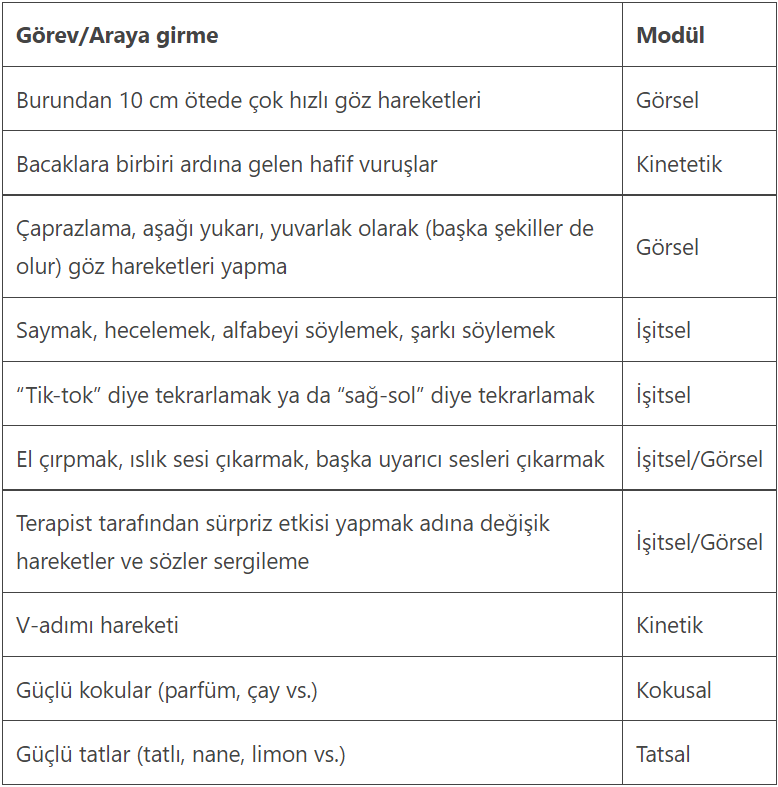
Working memory taxation can be maximized by combining different tasks. The client begins with tapping and very rapid eye movements. These sets combine very rapid eye movements with one or more of six different tasks: 1. Making eye movements in patterns other than horizontal, such as circles 2. Counting or spelling tasks 3. Repeating phrases that may cause slips of the tongue, such as tick-tock 4. Performing a V-step: Standing up and taking diagonal steps 5. Tapping tasks 6. Introducing distracting smells and tastes.
Adding the element of surprise
Surprising the client by making unrelated comments, asking questions about irrelevant topics (such as What do you think of the weather?) or making unexpected movements.
Inducing arousal
The therapist induces arousal by unexpectedly clapping, saying a word loudly, suddenly making unusual sounds, or making sudden movements.
Modality-specific taxation
The therapist tailors working memory taxation to the target memory. For example, if the target memory has a strong auditory component, an auditory taxation method is used alongside another method. (For example, counting and spelling for a memory involving loud breathing.) In addition to the visual, auditory, and kinesthetic tasks classified under maximized working memory taxation, various objects are available in the laboratory for modality-specific taxation.
Design
The study used a four (Time: pretest, posttest, follow-up 1, follow-up 2) by two (Condition: EMDR and EMDR 2.0) mixed design. Participants were randomly assigned to one of the conditions in their order of inclusion. The within-subjects variable was time, consisting of SUD and vividness ratings at the start of the experiment (pretest), after completion (posttest), at one-week follow-up (follow-up 1), and at four-week follow-up (follow-up 2). The between-subjects variable was condition, defined as EMDR or EMDR 2.0. For efficiency, the dependent variables were measures of total session duration and the number of sets performed. Sets were measured both in total and as an average per set.
Data Analysis
All data were analyzed using Bayesian methods in the statistical software JASP. BF>1 indicates support for the model; BF<1 indicates that the model is not supported. All group differences were assessed using ANOVA.
Results
Data from 62 clients were included in the analysis. At baseline, the mean emotionality of the target memories selected by clients was 8 on the SUD scale, while mean vividness was 7.99. Treatment lasted a maximum of 20 minutes in both conditions.
Emotionality
The results of the repeated-measures ANOVA, with condition (EMDR, EMDR 2.0) as the between-subjects variable and SUD ratings over time (Time: pretest, posttest, follow-up 1, follow-up 2) as the within-subjects variable, supported a model with a main effect of time only.
Post hoc tests showed strong support for a decrease in SUD ratings from pretest to posttest. SUD ratings did not decrease further after posttest; in other words, there was support for a model without further decreases between posttest, follow-up 1, and follow-up 2 ratings. The model with main effects of Time and Condition was not convincingly supported. There was strong evidence against the model that also included an interaction effect. Planned post hoc comparisons of decreases in SUD ratings from pretest to posttest, follow-up 1, and follow-up 2 supported the absence of differences between conditions.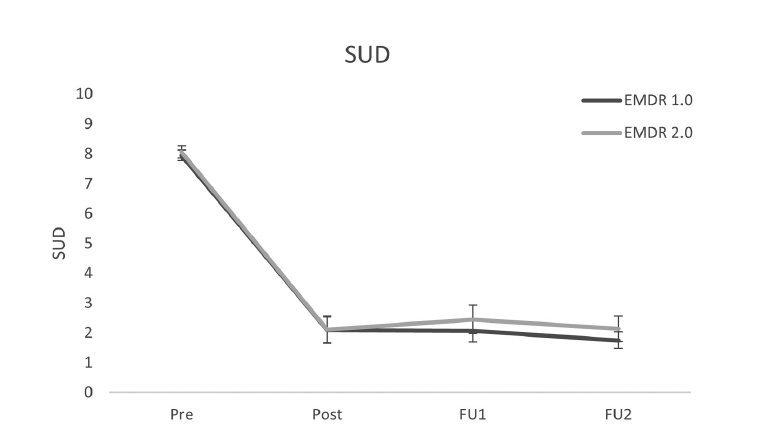
Vividness
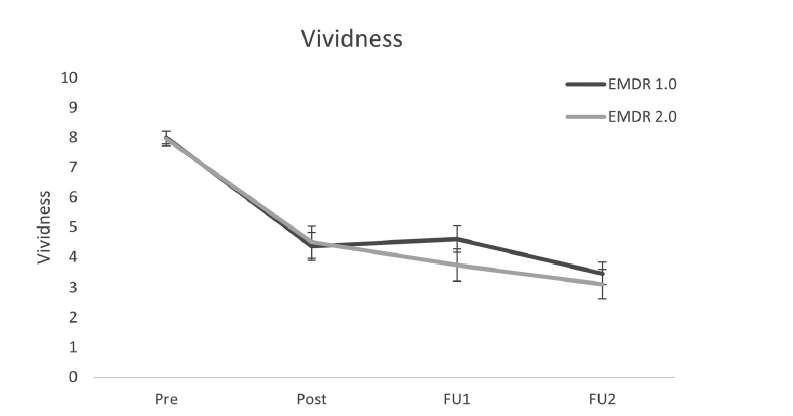
The repeated-measures ANOVA comparing vividness ratings over time between groups showed the greatest support for the model including only a main effect of time. There was a strongly supported decrease in vividness ratings from pretest to posttest. The analysis showed evidence against the model including an interaction effect. It supported models with equal decreases in vividness ratings across conditions and at specific time points.
Efficiency
There was no difference in session duration between groups. Participants in the EMDR 2.0 condition (M = 9.03; SD = 4.36) completed fewer sets during the session than participants in the standard EMDR condition (M = 12.90); SD = 6.30).
Discussion
The aim of this study was to compare the efficacy and efficiency of the EMDR 2.0 therapy protocol with the standard EMDR protocol in affecting the emotionality and vividness of distressing autobiographical memories in a healthy sample. The results did not support the hypothesis that EMDR 2.0 would be more effective than conventional EMDR therapy in reducing the emotionality and vividness of distressing memories, both immediately after the intervention and at one- and four-week follow-ups. Individuals showed equivalent effects in both treatment conditions. There was only partial support for the hypothesis that EMDR 2.0 would be more efficient than EMDR. Participants in the EMDR 2.0 condition required fewer sets than those in the EMDR condition to achieve the same reduction in emotionality and vividness. Conversely, the two interventions did not differ in session duration.
If fewer sets were needed in EMDR 2.0 to achieve similar effects, why was no difference in session duration or lower emotionality or vividness ratings observed? We could argue that the enhanced WM (Working Memory) loading used in EMDR 2.0 may have overloaded WM, making it impossible for some participants to keep the negative memory in mind. Recent research has repeatedly shown that WM taxation in EMDR follows a dose–response relationship, but participants must also keep the memory in mind to process it. The extent to which participants could keep the disturbing memory in mind while performing the dual tasks was not monitored. Reports from several participants in the EMDR 2.0 condition after completing the study—for example, admitting that they were happy to engage in the dual tasks so that they did not have to think about the distressing memory—lend further plausibility to this possibility. On the other hand, if no WM capacity had remained and participants had been unable to keep the memory in mind, no effects of EMDR 2.0 would have been observed. Future research should monitor whether participants keep the memory in mind while performing the dual tasks, and if they cannot, the dual tasks should be adjusted to their capacity.
Another quite plausible explanation for the absence of differences in time and effects is the time spent on other elements of the intervention. Considering that a set lasted approximately 30 seconds, active desensitization in EMDR 2.0 treatment took roughly 4.5 minutes, compared with 6.5 minutes in conventional EMDR. This suggests that most of the intervention time was occupied by other treatment elements. Returning to the target and explaining the dual tasks are examples. Moreover, because participants returned to the target more quickly in EMDR 2.0, it is clear that the return-to-target procedure also took more time. Another explanation for the lack of differences in session duration and effects may lie in the sample used and the memories associated with it. In clients with PTSD, more time is spent processing the memory, so desensitization to a SUD score of zero requires more sets. Given the non-clinical sample, the negative memories were likely easier to modify. Furthermore, because the memories were easy to modify, we could argue that there may have been fewer differences between the effects of EMDR and EMDR 2.0, as there may have been less need for additional motivation, activation, and/or desensitization. The data were collected from a healthy sample motivated to participate in this study, in contrast to the avoidance of distressing memories typically observed in patients with PTSD (American Psychiatric Association, 2013). EMDR 2.0 was developed specifically for individuals who do not respond to EMDR because they avoid fully activating a memory—an effect witnessed in clinical practice—and because standard doses of working memory taxation appear insufficient to produce an effect.
Although it did not make a difference in session duration, the finding that fewer sets were needed in EMDR 2.0 to achieve the same effects on desensitization and vividness reduction raises questions about the usefulness of following associations and the need for research on associations. Although positive effects on EMDR efficacy have been observed when allowing an internal associative process, the additional effect of associations remains an empirical question, and whether associations or their verbalization are an effective and therefore important component of EMDR treatment is debated.
Conclusion
This study has several limitations. The first is the use of a fixed maximum time limit of 20 minutes. This prevented us from detecting whether there would have been any difference in session duration if we had continued until the emotionality of all memories had been resolved. Comparing total duration would have allowed a more direct comparison of session lengths. In addition, 25 of the 62 participants in the sample reached a SUD score of zero, which is reflected in the mean session duration. However, this also indicates that some memories that were easier to modify contributed substantially to the means, potentially obscuring differences in the effort required for desensitization. No process measures were included to determine the rate of decline in emotionality ratings during the session. It is therefore difficult to obtain a more detailed understanding of the slope of the decline in emotionality or vividness. Future research could use longer sessions and consider process measures to better understand the decrease in emotionality ratings during sessions. Furthermore, although the use of a non-clinical sample sheds light on the identification of mechanisms, a limitation of using such a sample is the generalizability of the findings. Further research in patient groups is needed to determine whether EMDR 2.0 is an alternative that works better than standard EMDR for a particular group of clients.
Matthijssen, S., Brouwers, T., van Roozendaal, C., Vuister, T., & de Jongh, A. (2021). The effect of EMDR versus EMDR 2.0 on emotionality and vividness of aversive memories in a non-clinical sample. European journal of psychotraumatology, 12(1), 1956793. https://doi.org/10.1080/20008198.2021.1956793